London’s underwater time bomb loses its rusting spikes, but the danger remains
The removal of the masts from the SS Richard Montgomery reduces one structural risk, yet the ship's massive cargo of explosives stays in the Thames Estuary under constant watch.
By John Ferrari ·
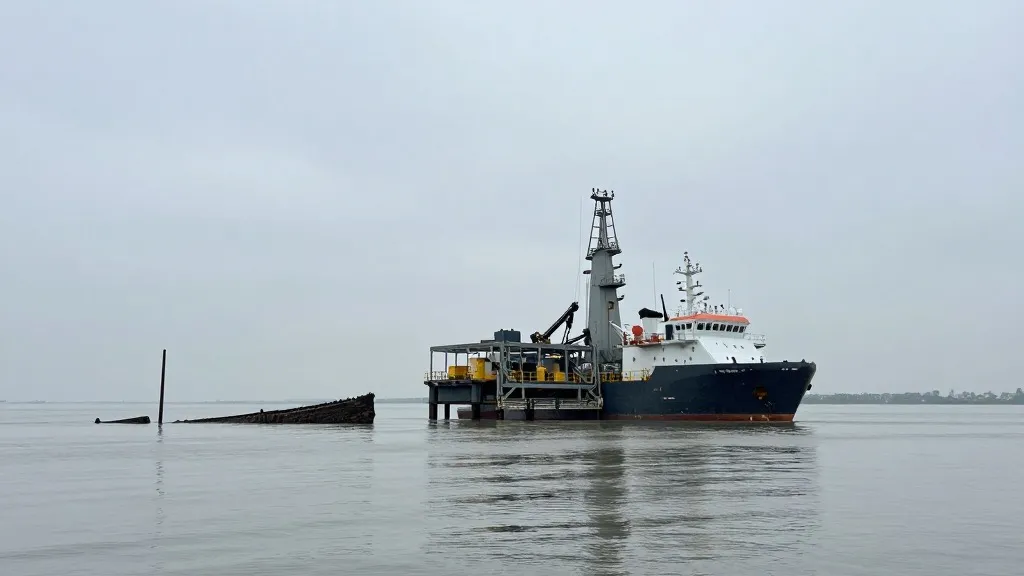
For the people living along the coast near Sheerness, a familiar sight has finally disappeared. The three tall, rusting masts that poked out of the water for decades are no longer there. This change is significant because those structures were the main visible sign of a hidden threat: a World War II shipwreck sitting on the riverbed, still loaded with a huge amount of unexploded ammunition. While the masts are gone, the explosives remain exactly where they have been for over eighty years.
The SS Richard Montgomery was one of thousands of vessels built in the United States to help the Allied forces during the war. In August 1944, the ship ran aground on a sandbar in the Thames Estuary, about forty miles from London. It was carrying munitions intended to support operations after the D-Day landings. During an attempt to save the ship, it broke apart and sank, leaving an estimated 1,500 tons of explosives in its cargo holds. For many years, the masts served as a marker for this dangerous resting place.
Recent inspections revealed that the structure was getting worse. Officials worried that the masts might eventually collapse. If that happened, the weight could crush the cargo below and trigger an explosion. Nolan Conway, a naval architect who led the removal effort, explained that the ship had started to lean. He noted that the fear was that the masts could fall onto the cargo and cause it to detonate. Some of the explosives are thought to have pressure fuses, meaning a hard impact could be enough to set them off.
Taking the masts down was a delicate task. The team had to cut them away without shaking the wreck or putting workers in harm's way. They built a special lifting frame to raise each mast straight up, preventing any swinging or swaying. Instead of sending divers into the water, they used a remotely operated underwater tool with a diamond wire. This device clamped around the mast with hydraulic arms and sliced through it, keeping human workers safely on the surface.
U.K. maritime minister Keir Mather announced in the House of Commons that the project was finished early and within budget. The total cost was just under 13 million dollars. Mather explained that the masts placed a significant load on the ship's structure. Removing them lowers that risk and helps manage the site safely for the long term. The job is now complete, but the work of monitoring the area continues.
The explosives themselves are staying put. Taking them out would carry its own set of high risks, so experts have decided to leave them in the cargo holds. There is still debate about what would happen if the cargo did explode. Conway said estimates vary widely. Some think it would only affect the shoreline, while others fear a tidal wave traveling up the Thames. Others believe it might be a smaller event that merely closes a nearby shipping channel. As Conway put it, the range of impacts is large, but none of the outcomes are good. Officials still judge the overall chance of an explosion to be low.
The government has maintained an exclusion zone around the wreck for a long time. The ship lies about 1.5 miles off the coast. Mather confirmed that the site will continue to be under continuous monitoring and control through that zone. This ensures that ships and swimmers stay at a safe distance from the underwater hazard.
The removed masts are not being scrapped. They have been moved to the Historic Dockyard Chatham museum. They will be displayed there to honor the ship's historic importance and its role in supporting Allied forces. The SS Richard Montgomery, along with its cargo, will stay where it sank. It is now completely out of sight, but it remains a part of local history that is far from forgotten.