7 in 10 Young Voters Backed Democrats in 2026 Midterms
New survey data reveals a sharp leftward shift among voters under 30, alongside notable gains for Democrats with Hispanic, Black, and lower-income voters.
By John Ferrari ·
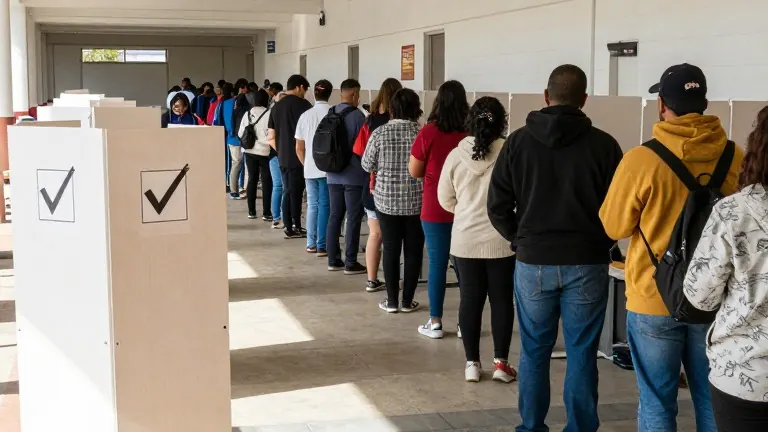
Democratic candidates reversed a two-year trend by winning back key voter groups in the 2026 midterm elections.
Data from The AP Voter Poll, which surveyed over 100,000 voters across all 50 states, shows that many of the demographic shifts seen in 2024 have flipped. President Donald Trump had made gains with parts of the traditional Democratic coalition during the 2024 presidential election, but this year’s results indicate a return to Democratic support among young, Hispanic, and Black voters.
Voters under the age of 30 displayed the most dramatic change in behavior. Approximately 70% of these young voters reported supporting the Democratic candidate in their local U.S. House race, compared to 30% who chose the Republican. In 2024, this age group was roughly split evenly between Donald Trump and Kamala Harris. While voters under 30 made up only about 10% of the national electorate, their sentiment was distinct. About half of young voters described themselves as angry about the direction of the country, a higher rate than the one-third of voters ages 65 and older who shared that view. Additionally, 60% of voters under 30 cited opposition to Trump as a primary reason for their vote, a figure higher than the 50% of voters ages 30 to 44 and the 40% of voters ages 45 and older who felt the same.
Hispanic voters also moved toward the Democratic Party, particularly in Texas. Nationally, about 60% of Hispanic voters backed the Democratic House candidate, while only about 30% supported the Republican. Two years prior, roughly 40% of Hispanic voters supported Trump. In the Texas Senate race, Democrat James Talarico defeated Republican Ken Paxton with strong support from this group. The poll found that about 60% of Hispanic voters in that contest chose Talarico, whereas only 30% voted for Paxton. In Florida, Republican Senator Ashley Moody won reelection with a narrow margin, but she secured support from less than half of Hispanic voters, a drop from the definitive support Trump received from the group in 2024.
Black men saw a sharp decline in Republican support. Only about 10% of Black men voted for the Republican candidate in their local House race, down from the quarter who supported Trump in 2024. Conversely, about 90% of Black voters supported the Democratic House candidate, an increase from the 80% who voted for Harris. This shift played a role in the Georgia gubernatorial race, where Keisha Lance Bottoms became the first Black woman elected as governor. About 90% of Black men voted for Bottoms, compared to the 75% who supported Harris in 2024. In Florida, Republican Byron Donalds, elected as the state's first Black governor, secured support from about 25% of Black men and 10% of Black women, figures that contrasted with the higher Democratic support in Georgia.
Moderate voters also leaned toward Democrats, particularly in competitive Senate races. Roughly two-thirds of moderates supported the Democratic House candidate, up from the 60% who backed Harris in 2024. A large share of these voters, about 80%, said Congress was not doing enough to check presidential power. In Kansas, Democrat Adam Hamilton won about 70% of moderate voters, a jump from the 50% Harris received. In Iowa, Democrat Josh Turek captured two-thirds of moderates, and in North Carolina, Democrat Roy Cooper won about 75% of that group.
Economic anxiety drove lower-income voters toward the Democratic side. More than half of voters with a 2025 household income under $50,000 voted for the Democratic House candidate. This group was evenly split between Trump and Harris in 2024. About 30% of U.S. voters reported a household income below $50,000. These voters were more likely than wealthier counterparts to cite food, gas, and utility costs as major concerns. About 60% of voters earning under $50,000 said the cost of living was crucial to their decision, compared to 50% of those earning $50,000 or more.
The combination of these demographic shifts helped Democrats secure victories in several key Senate races, including in Texas, Kansas, Iowa, Ohio, and North Carolina.