Iowa Farm: From 8,000 Hogs to Lion's Mane
The Faaborg family has converted a portion of their former concentrated animal feeding operation into a specialty mushroom business with the help of a nonprofit.
By Alessia Romano ·
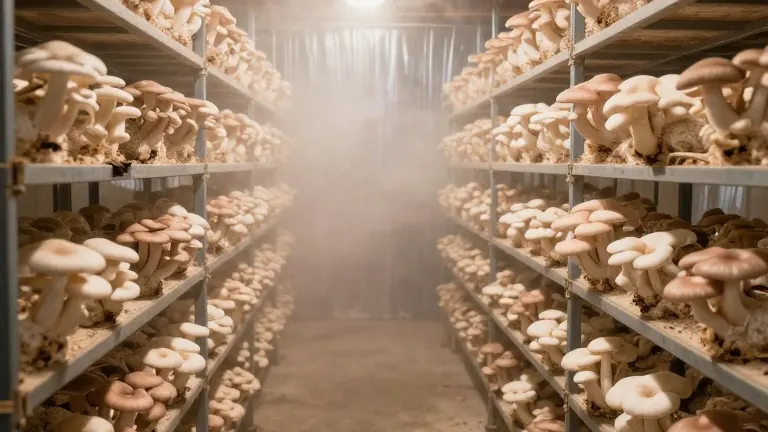
Fog drifts across shelves of sprouting fungi inside a dimly lit building in central Iowa. Tyler Faaborg, a former hog marketer, checks on lion's mane mushrooms that are weeks away from harvest. The family now grows these specialty fungi in a space that once held thousands of pigs. They sell the crops as tinctures, coffee blends, and flavored salt under the name 1100 Farm.
The farm's name references the number of hogs each of their two barns held for decades. The Faaborgs recently completed the conversion of half of one 200-foot-long hog barn this summer. This retrofitted space allows them to scale production following a successful pilot project. It also serves as the second demonstration hub in the United States for The Transfarmation Project, a program run by the charity Mercy for Animals. The first hub is located at a former chicken farm in North Carolina.
Katherine Jernigan, the director of Transfarmation, explains that the organization provides technical and financial support to industrial animal farmers looking to switch to sustainable practices. The group offers open-source blueprints for converting pig, poultry, and dairy barns. Jernigan notes that the program focuses on repurposing existing infrastructure rather than requiring new construction. This approach helps farmers retain their current assets while changing their operations.
The family began working with Transfarmation in 2021 and sold their last herd of hogs in 2022. In 2023, they used a $15,000 grant to experiment with mushroom growth and product development. The initial pilot project cost approximately $35,000, covering site preparations, supplies, branding, and website development. The Faaborgs are now part of a four-year contract with Transfarmation that pays them $216,000 for tracking and sharing production data.
Rand Faaborg, the family patriarch, bought the 25-acre farm in the 1980s. He initially raised market hogs for extra income before moving to a contract feeding model. Under this arrangement, a company provided the animals and feed while the family provided labor and infrastructure. Rand Faaborg retrofitted existing buildings to hold 2,000 hogs at a time. He described the work as profitable but physically demanding, noting that he often worked 16 to 24-hour days. The family eventually financed two new barns at a cost of over $400,000, taking 12 years to pay off the debt.
The transition away from hogs was driven by shifting economics and environmental concerns. Rand Faaborg noted that his pay from raising hogs dropped by two-thirds over 35 years, while his welding job salary increased tenfold. The farm produced roughly a million gallons of liquid manure annually, stored in an open pit. The U.S. Environmental Protection Agency states that methane from manure pits is 28 times as potent as carbon dioxide at trapping heat. Tanner Faaborg, who spearheaded the new direction, wanted to utilize the existing infrastructure for a healthier and more profitable model.
The family has converted the former manure pit into a freshwater pond with funding from the U.S. Department of Agriculture Natural Resources Conservation Service. Rand Faaborg says the pond now supports frogs and ducks, replacing a source of daily anxiety with a local habitat. The family is also planting native grasses, wildflowers, and hundreds of trees and shrubs to improve water quality and support wildlife. They plan to convert the second hog barn in the future, possibly for microgreens.
Tanner Faaborg views the operation as a proof of concept for other farmers. He hopes the transparent sharing of costs, labor hours, and product margins will help others make the switch. The family aims to sell fresh mushrooms to local companies and eventually use an empty grain silo as a visitor space. The goal is to create a model that is financially viable for the family while benefiting the surrounding community and environment.
More Business · Consumer Watch · Report a business · Got a Story?