Supreme Court Lifts Injunction, Allowing Border Wall Construction to Resume in West Texas
The high court ruled that federal authority to expedite border security supersedes environmental concerns, clearing a 500-mile stretch for immediate work.
By Alessia Romano ·
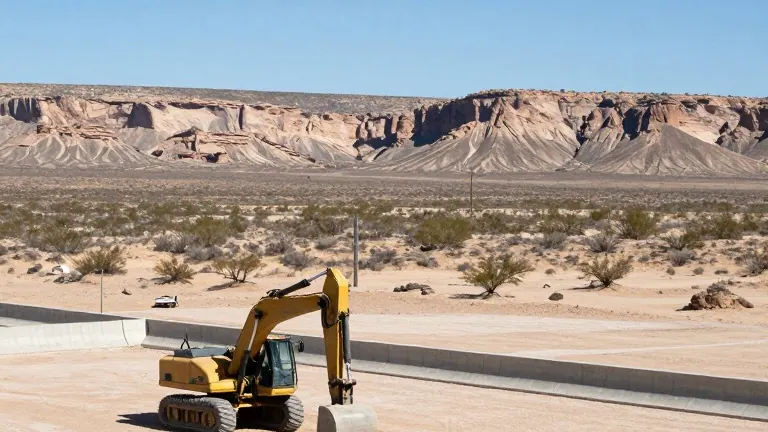
The Supreme Court issued an unsigned decision on Monday that removes a legal barrier to border infrastructure projects in West Texas. The ruling lifts a district court injunction that had temporarily halted construction of a 30-foot bollard wall and associated roads in the Big Bend sector. This move allows the Trump administration to resume immediate work on a project that spans more than 500 miles of the southern border.
The court’s five-page opinion emphasizes the federal government’s compelling interest in border security and integrity. The justices stated that the lower court order impeded the government's ability to advance these interests. They noted that Congress enacted immigration laws permitting the Secretary of Homeland Security to waive environmental and conservation requirements to ensure expeditious construction. The court found that this statutory preference supports moving forward with the project despite objections from local stakeholders.
Justice Ketanji Brown Jackson dissented from the emergency relief granted by her colleagues. She indicated that she would have denied the Justice Department's request for immediate action. The majority opinion acknowledged that challengers claim the construction will diminish their ability to use and enjoy the area. However, the court ruled that the legal framework favors speed in border construction over the specific harms asserted by the respondents in this case.
The litigation involves a coalition of plaintiffs including the Center for Biological Diversity, a professional riverboat guide, and a religious organization. These groups argue that resuming work will permanently alter an irreplaceable landscape that includes Big Bend National Park and nearly 200 miles of the Rio Grande Wild and Scenic River corridor. Laiken Jordahl, the national public lands advocate for the Center for Biological Diversity, stated that the decision allows contractors to bulldoze pristine desert and dynamite canyon walls before a final legal determination is made.
The Department of Homeland Security invoked a 1996 federal immigration law to issue three waivers for the Big Bend region beginning in February. This legal tool allows the secretary to bypass standard environmental review processes to accelerate barrier construction. Solicitor General D. John Sauer warned that halting the project would create a massive vulnerability in border protection. He argued that stopping work would disrupt the government's ability to secure a quarter of the southern border against cartel incursions and drug trafficking.
U.S. District Judge Kathleen Cardone originally granted the preliminary injunction last month. She found that the Secretary of Homeland Security exceeded his authority when issuing the waivers that permitted the construction to proceed. The administration contends that immigration officers apprehended more than 89,000 people attempting to cross illegally in that area between 2021 and 2025. This data supports their claim that the Big Bend sector requires additional border barriers to manage high levels of illegal entry.
Plaintiffs in the case dispute the characterization of the area as a high-traffic zone for illegal crossings. Court filings show that the Big Bend sector covers more than 25% of the U.S.-Mexico border. Despite this large geographic area, annual apprehensions in the sector ranged between 0.3% and 2.2% of total border-wide apprehensions. The plaintiffs argue that these figures indicate the area ranks last for apprehensions compared to the other six sectors along the southern border.
Construction of a 47-mile stretch of wall in Hudspeth County began in September. Customs and Border Protection Commissioner Rodney Scott previously announced a pause in operations until the end of September following public backlash over bulldozers entering Big Bend National Park. Scott stated that the proposed 30-foot wall will not cut through the national park, but other infrastructure will include more than 200 miles of patrol roads and roughly 17 miles of a vehicle-barrier system.
More Business · Consumer Watch · Report a business · Got a Story?