Moon Water Reserves Limit City Size
Harvard researchers say lunar water stocks support 10,000 people for centuries, not millions.
By Luana Sato ·
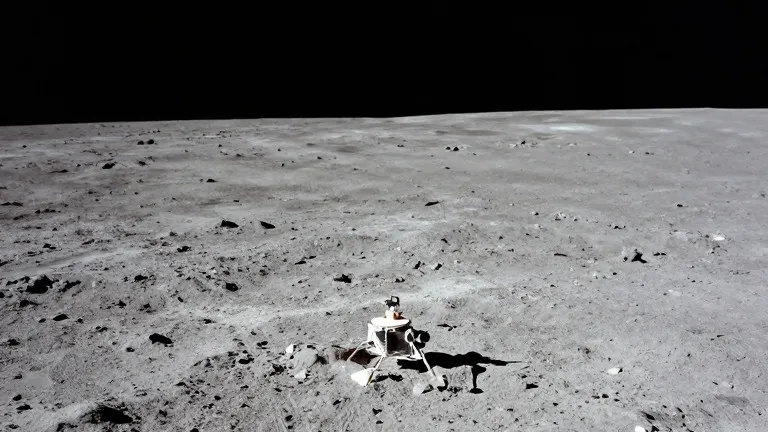
Lunar cities may stay small.
A new analysis published in Frontiers in Space Technologies argues that the moon's limited water supply cannot sustain massive populations. Martin Elvis, a senior astrophysicist at Harvard University's Smithsonian Astrophysical Observatory, and Jonathan McDowell, an honorary professor at Durham University's Space Research Centre, examined the viability of large-scale settlements. They found that while power generation is feasible, water availability poses a strict constraint.
The study challenges recent statements from tech leaders. In February, SpaceX CEO Elon Musk stated that the company aims to build a self-growing city on the moon within a decade. Blue Origin CEO Jeff Bezos has projected that millions of people will live in space by 2045. The researchers tested these projections against current estimates of lunar resources. They concluded that a population of one million would exhaust available water in roughly 100 years, assuming a 98 per cent recycling rate similar to the International Space Station.
The total water reserve is estimated at one billion tonnes, mostly located in permanently shadowed polar regions. Elvis described this volume as modest, comparing it to an aquarium the size of Central Park filled until the Statue of Liberty is submerged. He noted that such a supply is insufficient for a major metropolis over the long term. A settlement of 10,000 residents, however, could remain sustainable for centuries under the same conditions.
The assumptions in the model may be optimistic. Elvis suggested the one-billion-tonne figure could be 20 or 30 times larger than the actual recoverable amount. He estimated that only one per cent of the original figure is reliable, which would reduce the 100-year timeline for one million people to a single year. Gordon Osinski, a professor of planetary geology at Western University, added that satellite measurements contain uncertainties. He noted that the water may exist as sub-millimetre ice crystals mixed into soil, resembling Arctic permafrost and making extraction difficult.
McDowell emphasized that the findings clarify the scale of the challenge. He stated that the goal should be to find methods for transporting water to the surface if it is not readily accessible. The researchers aim to provide a realistic framework for future planning rather than a negative verdict on lunar habitation. The paper details these constraints in the journal Frontiers in Space Technologies.